Tuesday, May 31, 2011

Latin and the SAT

There is some interesting statistical information for Latin teachers and students in the 2010 College-Bound Seniors Total Group Profile Report by the College Board.  It is accessible here: http://professionals.collegeboard.com/data-reports-research/sat/cb-seniors-2010

The information suggests a little inquiry into how students who take Latin fare on the Reading, Mathematics and Writing tests vis-a-vis students who take other languages and vis-a-vis students taking other subjects (not necessarily excluding foreign languages as well, I suppose).  The base line is the average for all 1.5 million test-takers (Table 1):
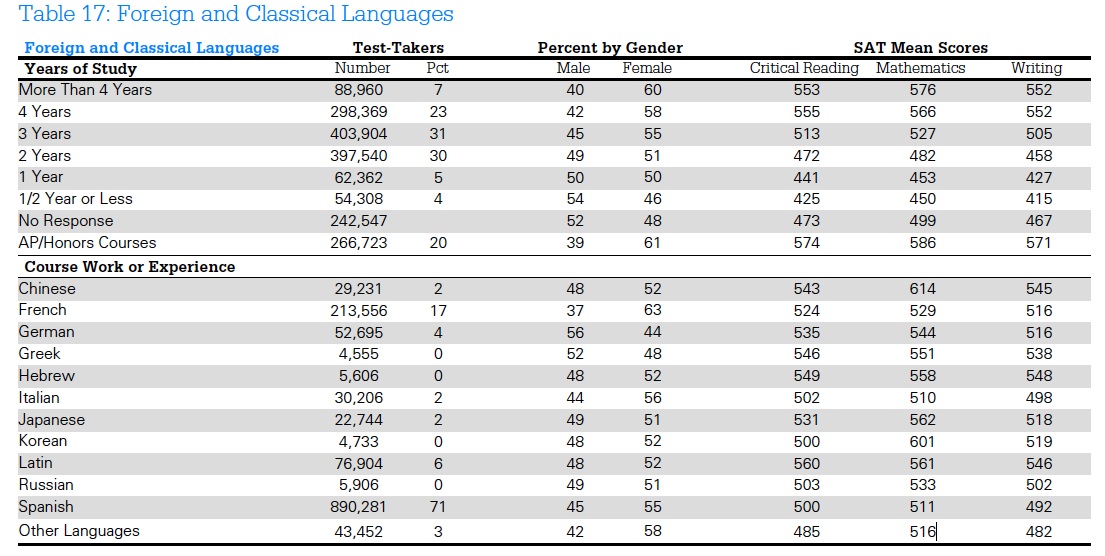
Table 17 offers SAT mean scores for students taking different foreign languages, both by language and years pursued (including AP/Honors Courses). 
In the total of the mean scores, Latin (1667) is exceeded only by Chinese (1702).  Latin is 50 to 60 points above the national average on each of the three mean scores.  Spanish is almost dead on the national average.  French - the other subject I teach - is in between.  There are almost 11 times the number of Spanish students as Latin Students and almost three times the number of French students.  As one would have suspected students who have taken an AP/Honors course or have pursued the study of a language at least four years or both, have significantly higher reading, math and writing mean scores than those who have not.  Unfortunately this particular sub-set of data is not broken down by language.  Where Latin stacks up with respect to correlations with other course work is more fully developed in Tables 15 - 18 (the others of which I am not going to cut and paste here).  In these the figures indicate that of all the other course work mentioned (ten for English, five for Math, five for sciences, ten for History, eight for the Arts, six for Computers, as well as the nine other Foreign Languages besides Latin), only those taking Calculus (total mean scores: 1748 for 356,931 students) and Chinese (total mean scores: 1702 for 29,231 students) have higher mean SAT scores than were achieved by the 76,904 takers of Latin courses (total mean scores: 1667). 

Just as one comparison - since courses revolving around the operation of computers seem to be proliferating - here is the same set of mean scores correlated with courses in, e.g., computer literacy, computer programming and the like.  Since these are all around or close to the average scores, there would seem to be little correlation between these academic pursuits and better than average SAT scores.
Table 20 offers the same data for students who took various subject tests.  I break this down into two tables, one for the language tests and the other for English, History, Math and Science tests.

This tends to suggest that for students with sufficient confidence in a subject to sign up for a subject test, among foreign language students Latin students are easily in the top position with respect to their mean scores in Reading and Writing, and second only to Chinese students in Math (by only 3 points).  I note that all the scores on this chart are way above the national averages, though again Spanish students are in the bottom position relative to the others.  The Latin students also outscore in their mean Reading, Math and Writing scores all others testing in English, History, Math and Science, with the exception of Chemistry and Physics students who outscore them in Math.  I suspect it is also noteworthy that the standard deviation on the three main tests for those taking the Latin subject test is the lowest of the whole bunch, indicating that these scores are all clustered more tightly around the numerical average. 

One other interesting comparison is found in the tables on the Subject Tests Score Distributions (tables 21 - 24).  I include here only table 24:
Table 23 shows similar distributions for Chinese, French, German and Hebrew.  It looks like Latin students were the least prepared to perform at the highest level on their particular subject test of any students taking any language subject test, and the distribution of their scores was almost even in each 50th from 800 down to 500.  Nevertheless, as was obvious from Table 20, there is something about this particular group of 2,874 students which is correlated with a set of very high mean SAT scores. 

I really don't know what that something is.  There may be something about Latin that leads those who pursue its study for several years to have a higher than average competency level in reading comprehension, mathematical reasoning and writing skills.  On the other hand, those who have higher than average competency levels in reading comprehension, mathematical reasoning and writing skills may gravitate (or be pushed) toward the study of Latin.  Maybe there is something to both explanations.

The other question - related but perhaps more perplexing - is why the number of Latin students is so relatively low.  Note that the number of students taking the Latin subject test is one percent of the total number of students taking subject tests.  Note that the number of students who reported having taken Latin (76,094) is about five percent of the total SAT test takers (1,547,990).  In my small high school (about 600 students fairly evenly distributed in grades 9 - 12), this year (2010-2011) there have been two Latin IV students and one Latin III student, zero French IV students and three French III students - i.e., about one percent in upper level Latin and in upper level French.  There are about 30 French and 30 Latin students altogether over all four grade levels.  There are more than twice as many Spanish students. 

One would think that if high SAT scores really mattered there would be a lot more students taking Latin.  Either hardly anybody has been paying attention to this batch of statistics (and they seem to have been pointing the same direction for years - check out Bolchazy-Carducci's [less than wholly candid] Latin advantage page), or perhaps only about five percent of the population actually has enough competency in reading comprehension, mathematical reasoning and writing skills to take Latin. 

Sunday, October 31, 2010

Labor improdus omnia vincit


This is the motto of Fond de l'étang - a boarding school for wayward boys in post-WWII France and the setting for Les Choristes, a 2004 French film directed by Christophe Barratier. A couple years ago I bought a DVD to watch with my French classes on the recommendation of my son who had spent a year in France a decade ago as a foreign exchange student. The motto - in large capital letters - appears one time in the film on a wall in a hall of the building as the new master is introduced to the place. Beneath the Latin and at the right is the ascription "Vergile".

Why is this motto so laughably mistaken? Vergil says in his Georgics I.145-6:
. . . labor omnia uicit 145

improbus et duris urgens in rebus egestas.
A troublesome sentence to comprehend although not terribly difficult in vocabulary and syntax.

At the Erreurs de Films page on this movie appears this comment by "Michel B":
La devise du 'fond de l'étang', apparaît à un certain moment : 'labor improdus omnia vincit' ne signifie rien en latin. Il faut lire 'improbus' et non 'improdus' (Barbarisme).
Possibly the error is intentional. The phrase in the motto has been around a good while. It produces at least 250 hits on Google (mostly European), among which appear glosses like this: Un travail opiniâtre vient à bout de tout. E.g. from the Institute of Physiology and Pathology of Hearing:
Officer's Cross "Labor Improdus Omnia Vincit" for scientific achievements of the Institute of Physiology and Pathology of Hearing, awarded at the 57th World Exhibition on Innovation, Research and New Technologies INNOVA 2008
It seems to have been adopted as a tag-line by somebody going under the name "Gael" in a French listserv of some sort called Forum des Coquillards de Villon. You can see a representative post here. Of course, a goodly number - perhaps most - of the postings since 2004 may be parroting this film, wittingly or not, though it seems doubtful that the Officer's Cross thing derives from the movie, or at least from this version of the movie.

By contrast, the less incorrect "Labor improbus omnia vincit" produces some 18,000 hits on Google, and the shorter version (omitting the problematic attributive adjective) "Labor omnia vincit" some 67,000.

Perhaps the director or possibly the screenwriters (Barratier and Philippe Lopes-Curval, who were adapting the 1947 film La Cage aux Rossignols) have included this bit as a subtle - or not so subtle - comment on the pretensions of this internat de rééducation réservé aux enfants en difficulté. Throughout the film representatives of the school's administration confidently babble in (then) current psycho-socio-educational buzz-words, but they cannot even get a simple Latin quotation right on their proudly displayed motto. Rather, with a complete lack of genuine discernment, they latch onto some debased Latinate hard-work-is-good-for-you proverb floating around here or there and paste it up where it will impress the hoi polloi.

Perhaps it even goes further with a gentle but telling cut at the growing shallowness of a society coming adrift from its cultural roots. After all, nobody in the film comments on the error, or even appears to notice it. Nobody's education has included enough time with one of the preeminent writers of antiquity to recognize a misquote prominently displayed on the wall.

On the other hand, this may have appeared in the earlier film and simply been copied. In that case, we are back to wondering the same things about those involved in that earlier production.

Or is the real answer, as "Michel B" suggests, that these film people (whether in the later or the earlier or both versions of the story) just wanted a Latin motto saying something about the value of work and were too hasty and too cheap to get it right.

Saturday, October 30, 2010

Attendance, participation, cooperation and effort are the grade criteria applied by one physical education teacher (with thirty years or more of experience) at my school. I'm not sure why I asked him. He doesn't have a classroom this year, so I see him regularly in the science wing's utility room where there is a coffee-maker for the third floor. He was there working on grade entry work on his laptop when I stopped by for a re-fill one afternoon. I've been wondering a lot about grades the last few years, so I just inquired.

I suppose this set of criteria results in fairness. Students with little or no athletic ability (regardless of their motivation) and students with little or no ambition to reach a high level of accomplishment (regardless of their natural talent) can earn an A by attending, participating, cooperating and making an effort. The level of actual achievement in athletic pursuits, whether individual or group, indoors or outdoors, high-intensity or low-intensity, over the semester or academic year or even all four years of high school is irrelevant under this criteria. This may entail a dilution of the accomplishment of those who actually have a lot of ability or ambition or both, and consequently come to perform at a level of excellence, but who cares? By necessary implication that group of students will have attended, participated, cooperated and made an effort, so they will have their As too.

In my school an A for a semester of phys ed counts the same weight on the cumulative grade point average as an A for a semester in Latin. I can't help thinking that learning enough Latin vocabulary, morphology and syntax, and practicing thinking with all that Latin vocabulary, morphology and syntax well enough, to get As on my tests, quizzes and projects is necessary for a student to get an A in Latin. No doubt there is some correlation between this attitude of mine and the fact that there are three students in the third and fourth years of study in Latin out of a high school population of 600.

Statistic (from CDC): From 1980 through 2008, "the prevalence of obesity among adolescents aged 12 to 19 years increased from 5.0% to 18.1%" Is the appropriate reaction? (1) What the hell lousy kind of phys ed programs are schools running! (2) Without a phys ed course requirement this would be even worse. (3) Both?

Does anybody besides me wonder whether there is any causal relationship between the increasing number of fat kids and giving teenagers As in Gym if they show up, take part, get along nicely and give the impression of trying?

At least gym teachers are fortunate the bureaucrats in charge of such things as NCLB and PSSA haven't figured out how to hold schools responsible for making Olympic contenders out of whatever percentage of teenagers can fairly be described as porkers, weaklings, wimps or klutzes.

Sunday, December 6, 2009

My youngest grandson - Austin Giles Snyder - born November 25, 2009.
It looks like he's been searching for the words with which to express his disapproval of something he has just noticed about his immediate environment and is just about to realize that he doesn't know any words yet, which is another thing he's about to disapprove of, except that the same problem with not knowing any words is going to come into play there as well, in consequence of all of which he can't do much of anything except get that expression on his face.

Wednesday, August 5, 2009


Just a little something to give notice of my son's exhibit, currently up at the Bedford County Arts Council in Bedford.

Friday, February 27, 2009

Facetiae hebdomadae 2/23 - 2/27/09 -

Vir quidam intrat in grapheum causidici et rogat de pretio operis eius.
Cui ille: Si tibi tres quaestiones respondebo mihi quinquaginta dollarios dabis.
"Eheu, mi frater," clamat vir, "nonne putas hoc magni pretii esse?"
"Ita," ait causidicus, "et nunc, mi domine, quae est quaestio ter-tia?"

Quae differentia inest inter pulicem et causidicum?
Postquam mortus es pulex tuam non magis sanguinem sugit.

Si in minimo cubiculo es et illic tigris ferocissimus, vipera ve-nenossima et causidicus tecum insunt et tu tantum duas glandes plumbeas in sclopeto habes, dic mihi, quid primo facere debes?
Causidicum sclopetare. Bis!

Quid habes cum tu centum causidicos tenus collo in harena sepelivisti?
Non satis harenae.

Mulier et vir qui antea numquam sese obviam intulerunt ideoque inter se prorsus ignoti, comperierunt se casu eidem conclavi in tramine transcontinentali ascriptos esse. Alium lectum in curri-bus cubiculatis consequi temptaverunt sed tramen oppletum erat vectoribus et valde defessi erant peregrini advenae nostri. In his angustiis foro uti consenserunt hac dumtaxat nocte et vir urbane sibi selegit lectum superiorem ut res commodius mulieri eveni-ret. Intempesta nocte vir declinavit miteque mulierem e somno suscitavit dicens, "Hera mea, me paenitet si te incommodem, sed in armarium illud manum porrigere velin' ut mihi adipiscaris al-teram lodicem? Maxime enim frigeo."
"Melius consilium capiendum ut mihi videtur, tibi habeo," refert mulier. "Hac sola nocte fingamus nos esse coniuges."
"Hui! Valde mihi arridet ratio illa tua!" exclamat vir.
"Bene est," regerit illa. "Adipiscere sis tibi tandem ipsi lodicem tuam paedicandam."
Jokes from week of 2/16/09 -

Quondam homo ebrius quidam in via cecidit atque graviter ictu vulneratus est. Cum deinde domum delatus est, uxor flava, ubi primum medicum vidit, eum interrogavit num maritus in dis-crimine vitae esset. Medicus, homo in arte sua excellens, postquam accurate hominem inspexit, uxori respondit: "Plane mortuus est. Mox poteris corpus eius in rogum imponere." Cum haec verba audivisset maritus, qui nondum mortuus erat, dixit voce supplici: "Nolite me cremare vivum. Expectate dum moriar!" "Tace," inquit uxor, "num te scire plus quam medicus existimas?"


Vir quidam Amstelodami ecclesiam init et antistiti dicit se con-fiteri velle.
“Ignosce mihi, pater,” ait vir, “quia peccavi. Inter annos alteri belli mundani virum in parvo cubiculo sub tegulis celavi.”
“Mi fili,” respondet antistes, “hoc nullum peccatum est.”
“Sed, mi pater,” ait vir, “ab eo quadraginta denarios per hebdo-madam cepi.”
“Quamquam hoc,” respondet antistes, “non stricto sensu bonum est, verumtamen non peccavisti.”
“Eheu, mi pater, levavisti permagnum onus e conscientia mea,” dicit vir, “sed adhuc aliquid in mente habeo. . .”
Cui antistes: Ita, mi fili, quid rogare vis?
“Num debeo ei dicere bellum alterum mundanum iam peractum esse?”


Ex hoc quidem oppido missi sunt quidam Aretium ad emendum ligneum Crucifixum, qui in ecclesia eorum poneretur. Deducti ad hujusmodi opificem quemdam, cum rudes et veluti stipites essent, opifex risus materiam auditis hominibus quaerens, vi-vumne an mortuum Crucifixum vellent, postulavit. Illi, sumpto paulo temporis ad consultandum, secreto collocuti, demum re-sponderunt, se vivum malle: nam si eo modo suo populo non placeret, se illum e vestigio occisuros.
GIAN FRANCESCO POGGIO BRACCIOLINI (February 11, 1380 – October 30, 1459)


Marītus uxōrī suae articulum diurnārium legēbat dē numerō vōculārum quibus mulierēs quotīdiē peraequē ūtī solent... trīgintā mīlia contrā virī quīndecim mīlia. Huic regessit uxor, "In causā dēbet esse quod uxōrī opus est omnia bis repetere." Dein marītus ad uxōrem conversus rogāvit, "Quid?"