What's up with prefaces in Latin?
Consider Poe's 1842 story The Pit and the Pendulum, which he introduces with this pair of elegiac couplets:
Impia tortorum longos hic turba furores,
sanguinis innocui non satiata, aluit.
Sospite nunc patria, fracto nunc funeris antro,
Mors ubi dira fuit, vita salusque patent.
He adds this note: "a quatrain composed for the gates of a market to be erected upon the site of the Jacobin Club at Paris." He apparently got the lines here.
This introduction sums up the entire story. The impia. . . turba. . .sanguinis innocui non satiata - the bloodthirsty Inquisition dedicated to rooting out and destroying religious heresy - can hardly not be equated with the Jacobin Club - the bloodthirsty revolutionaries dedicated to rooting out and destroying political heresy. This unholy mob has fed its longlasting insanity, but now the land has been made safe, the murderous pit has been eradicated and where once there was terrible death, now there is life and well-being. In short, the narrator will not die. There will be a rescue.
This might seem to imply that for the author the ending of the story has almost no importance [note that this notion derives some support from the very abruptness and brevity of the concluding paragraph of the story], that the key thing is to have his reader focus on the elegant effectiveness of his evocation of the dread, terror and despair of someone undergoing this sort of physical and psychological torture. Of course the ending is not without any importance. Probably it was also one of the objects of the author to induce by means of his artistry, not only the necessary suspension of disbelief for any work of fiction, but also a certain oblivion with respect to the already known outcome. In other words one wonders more at the power of the prose for having been duped by it into vicariously participating in the narrator's struggle for life in the midst of such desperate circumstances. Note that without this consideration, the whole conceit seems silly: since the tale is told by a narrator, obviously he must have survived the experience in order to be telling it. With the preface Poe puts the silliness on the table and says to his intelligent reader: "I know you know how it ends - I just told you - now come with me into the mind and body of this narrator and watch me recreate the experience."
Poe could assume a readership adequate to his Latin preface in 1842, a readership knowledgeable about the major events of the relatively recent (within the preceding forty or fifty years) upheaval in France. I doubt that this is any longer the case. Indeed it is probable nowadays that not one in ten thousand high school English teachers (nor one in a million of their students) can read and understand this Latin preface, or know a Jacobin from a jack-ass.
If only a very few actually "get" the preface and its relation to the story, what really is the point of teaching The Pit and the Pendulum in the modern classroom? Is there much left of the story without the preface besides overwrought 19th century guff?
Tuesday, August 2, 2011

Friday, July 29, 2011
More Movie Latin
Les rivières pourpres is the title of a 1997 crime novel by French author Jean-Christophe Grangé. The book incorporates a pair of engagingly iconoclastic cops, some villainous academic types plotting world domination by eugenics and the fast pace of a typical pot-boiler. The author teamed up with Mathieu Kassovits (who played Nino Quincampoix in Le fabuleux destin d'Amélie Poulain) to write a screen-play, and the movie (English title - The Crimson Rivers) directed by Kassovits, became a big hit upon its release in 2000, according to Wikipedia "grossing $60 million in worldwide theatrical release."
The novel doesn't have a word of Latin in it, the movie otherwise. The headquarters of the villainous academic types is the Pôle Universitaire et Sportif de Guernon - somewhere in the French Alps. The logo for the place looks like this:

This appears on walls, shirts, jackets, etc. The Latin is, of course, the very familiar quote excerpted from Juvenal's Satires (10.356: orandum est ut sit mens sana in corpore sano.)
Besides this reference to the Silver Age satirist, a reference to one of the premier Golden Age poets shows up in a plaque that appears on a wall shortly after the arrival of Commissaire Niemans in Guernon:

Here we have a rendering in French of Vergil's line, Felix qui potuit rerum cognoscere causas, from the Georgics (Book II, line 490), and kind of a subtle, clever little thing equally apt for the detectives who will get to the bottom of things and for the Dr. Frankenstein imitators who think they have thought up a way to re-engineer the race. There is a reasonable possibility this is an intentional allusion on the part of the filmmakers since the phrase had shown up in an Astérix et Obélix story - Astérix en Corse (1973) - when the pirates experienced an explosion brought on by a Corsican cheese (Explosion provoquée par un fromage Corse), and since the line fetches over a hundred thousand French hits when googled in quotes.
So far so good. However, things start breaking down when the Latin gets carved in stone, or what passes for stone in a film. This appears above the entrance to one of the main buildings:
 It looks like this is a Latin rendering of what Grangé has one of the murdered villains (victim #2) write in his notebook (from page 199 of the novel), with the addition of the word "Scientia" (knowledge) above it:
Note that the reference to surveyors has been omitted and the word "sumus" (we are) both prominently and ambiguously (but fittingly for a lapidary style) placed so as to seem to apply, one surmises, not only to "scientia" (which may possibly be in the ablative case - though that possibility may be no more than a happy accident and in which case the verb might more appropriately be "fimus" or possibly "facti sumus") but also to the other nominal and adverbial predicates in the French. The problem is "purpereis rivis". The case is right, since "imperare" governs the dative, but the spelling of "crimson" is amiss; it should be "purpureis." As a color adjective it should follow its noun. The other troubling thing is that the word "rivis" is off as a translation for "rivières" - "cours d'eau naturel de moyenne importance ou qui se jette dans un autre cours d'eau (opposé à fleuve)" (Le Robert Micro). Better would have been any of the usual Latin synonyms for river: "flumen" or "fluvius" or "amnis." A "rivus" on the other hand is a "small stream of water, a brook" (Lewis and Short).
When we get to the first murdered villain's notebook, things take a decided turn for the worse. This is apparently the poor fellow's doctoral thesis and has a leather cover with another translation of the manifesto embossed on it, like this (sorry for the drastic cropping; couldn't get a good (legible) shot of the whole thing):
 As best I can tell this reads:
 This is subtitling so carelessly done as to seem surpassingly stupid, since there was no need to translate anything, just to read, i.e., print, the words written on the top line of the leather notebook cover: domini sumus. sumus servi.
Is it impossible for a film with a 14 million dollar budget to get a decent quality Latinist on board? What would the Latin look like in a better rendering? There are no doubt dozens of possibilities, but here is one rather straightforward suggestion (restoring the surveyor reference but eliminating the anaphora):
The novel doesn't have a word of Latin in it, the movie otherwise. The headquarters of the villainous academic types is the Pôle Universitaire et Sportif de Guernon - somewhere in the French Alps. The logo for the place looks like this:

This appears on walls, shirts, jackets, etc. The Latin is, of course, the very familiar quote excerpted from Juvenal's Satires (10.356: orandum est ut sit mens sana in corpore sano.)
Besides this reference to the Silver Age satirist, a reference to one of the premier Golden Age poets shows up in a plaque that appears on a wall shortly after the arrival of Commissaire Niemans in Guernon:

Here we have a rendering in French of Vergil's line, Felix qui potuit rerum cognoscere causas, from the Georgics (Book II, line 490), and kind of a subtle, clever little thing equally apt for the detectives who will get to the bottom of things and for the Dr. Frankenstein imitators who think they have thought up a way to re-engineer the race. There is a reasonable possibility this is an intentional allusion on the part of the filmmakers since the phrase had shown up in an Astérix et Obélix story - Astérix en Corse (1973) - when the pirates experienced an explosion brought on by a Corsican cheese (Explosion provoquée par un fromage Corse), and since the line fetches over a hundred thousand French hits when googled in quotes.
So far so good. However, things start breaking down when the Latin gets carved in stone, or what passes for stone in a film. This appears above the entrance to one of the main buildings:

NOUS SOMMES LES MAÎTRES, NOUS SOMMES LES ESCLAVES.
NOUS SOMMES PARTOUT, NOUS SOMMES NULLE PART.
NOUS SOMMES LES ARPENTEURS.
NOUS MAÎTRISONS LES RIVIÈRES POURPRES.
Note that the reference to surveyors has been omitted and the word "sumus" (we are) both prominently and ambiguously (but fittingly for a lapidary style) placed so as to seem to apply, one surmises, not only to "scientia" (which may possibly be in the ablative case - though that possibility may be no more than a happy accident and in which case the verb might more appropriately be "fimus" or possibly "facti sumus") but also to the other nominal and adverbial predicates in the French. The problem is "purpereis rivis". The case is right, since "imperare" governs the dative, but the spelling of "crimson" is amiss; it should be "purpureis." As a color adjective it should follow its noun. The other troubling thing is that the word "rivis" is off as a translation for "rivières" - "cours d'eau naturel de moyenne importance ou qui se jette dans un autre cours d'eau (opposé à fleuve)" (Le Robert Micro). Better would have been any of the usual Latin synonyms for river: "flumen" or "fluvius" or "amnis." A "rivus" on the other hand is a "small stream of water, a brook" (Lewis and Short).
When we get to the first murdered villain's notebook, things take a decided turn for the worse. This is apparently the poor fellow's doctoral thesis and has a leather cover with another translation of the manifesto embossed on it, like this (sorry for the drastic cropping; couldn't get a good (legible) shot of the whole thing):

DOMINI SUMUS. SUMUS SERVI.
UBICUMQUE. NUSQUAMQUE.
VERSAMUR PURPUREIS.
LUMINIBUS IMPERAMUS.
There are three problems with the Latin. There seem to be way too many periods (why would we be dwelling, staying, living, remaining or abiding in or with crimson things; or simply being or being circumstanced or situated with crimson things; or being occupied, busied or engaged with crimson things - "versamur purpureis" - when it would make more sense to assert that "we are (or abide) everywhere and nowhere? i.e., take "versamur" with both preceding adverbs and "imperamus" with the two words preceding it, as it is in the French). The translator has used the wrong word "ubicumque" (in whatever place, wherever; somewhere, wherever that may be ) for "ubique" (in every place, everywhere). And somebody left the "F" off "luminibus" which without that "F" means "lights" not "rivers". As might have been expected the subtitling is even worse:
Is it impossible for a film with a 14 million dollar budget to get a decent quality Latinist on board? What would the Latin look like in a better rendering? There are no doubt dozens of possibilities, but here is one rather straightforward suggestion (restoring the surveyor reference but eliminating the anaphora):
Nos, simul domini servique, fluminibus purpureis imperantes,
mensores, et ubique et nusquam versamur.
So, just a suggestion, Christophe, or Mathieu, or whoever does Les rivières pourpres III. . . Feel free to drop me a line the next time you think it's a good idea to punch up the symbolism in your next screen-play with a little Latin.
It has occurred to me since posting this originally that the fault may lie not so much with the contributor of the Latin rendering as with those who executed that contribution by preparing the stone inscription and the leather note-book cover. Certainly it would be rather unexpected to have tech people and other artisans who had upper-level Latin composition skills. I suppose that once the project got into the editing room - if indeed anybody even at that point noticed the problems - it was too late to do anything about it.
It has occurred to me since posting this originally that the fault may lie not so much with the contributor of the Latin rendering as with those who executed that contribution by preparing the stone inscription and the leather note-book cover. Certainly it would be rather unexpected to have tech people and other artisans who had upper-level Latin composition skills. I suppose that once the project got into the editing room - if indeed anybody even at that point noticed the problems - it was too late to do anything about it.
Thursday, July 21, 2011
time machine
I think I'll invent a time machine, kind of a cool looking box like one of those Apple computers, that start at $599, like this:

On my flat little squarish thing with rounded corners and the logo on top (note: I might skip the logo since the apple is probably proprietary and a watermelon would be too big, a grape too small, and a banana too long, yellow and phallicky. . . maybe I could try a negative image of itself - a slick drawing from a unique perspective - scaled down to about the same ratios as this one . . . oh, I don't know; I hate having to be creative) just as with this one, there wouldn't even be a button to start it. You'd just put it on your desk or coffee table and it would apparently do nothing for what would seem like forever and then at some unspecified, undesignated, indeterminate time in the future it would just work and suddenly you would see some kind of touch screen in the air hovering over it with images and text for suggested times and places to go visit in the past - maybe clickable ads for popular venues and things to wear and drink when you're there - and a box you could type in some address or other like Google Earth with a date and time of day, and then, zoom, you'd just go there to that place and time. Yes, you could type, because the thing would be projecting a holographic keyboard like this nifty little gizmo here:

The more specific the coordinates of the location on the space-time continuum you input, the better chance you would have of not ending up in a wall or a freeway or congress or something.
While waiting for it to become active, you'd just go about your daily life, such as it is and whatever it is. Or you could sit and stare at it like a TV. I could even invent a remote for it. There would be no apparent effect from clicking up or down the range of channels, but the exercise might have something to do with the mechanism for the activation of the machine itself. Probably most people would not notice any difference between doing this with the time-travel box and doing it with regular TV.
Whatever time and place you pick to time-travel to, the box would instantaneously give you fully developed skills in the language spoken and written there, so you could understand Homeric Greek or Elizabethan English or the Italian of the Renaissance or Rap Music without having to buy Rosetta Stone. I think it would do this by a process of molecular transformation of your brain which would be necessarily incidental to the manipulation of the time-space continuum entailed by time travel in the first place. Or maybe there would be a sort of wireless upload direct to the brain of something digitalized from the stem-cells of geniuses. Wait, both those ideas sound a little unscientific. This might be better. The box, upon becoming active, does its little number and sends itself far enough into the future where somebody smarter than I am has thought all this out, uploads whatever app is necessary for it to handle this language thing and then returns to your desk or coffee table instantaneously as if nothing had happened and you were still just staring at it, waiting for something to happen, idly clicking the remote.
Ooh ooh, I just remembered, it probably would be necessary add a thing in the holographic touch screen so you could set a duration for the trip, since once you got back to, say, the Renaissance, you'd have to wait a significantly longer time for the box to be invented in order to program yourself back to the present. Most people probably would not live that long. On the other hand, suppose you changed your mind and wanted to stay there, or you're in the middle something you really want to finish and forgot what time it was. . . Needs more thought. Or maybe I could just have the box include a life-expectancy enhancer as part of the overall time-travel experience which the box is capable of producing. . . yeah, that's it, some kind of a cross between a five hour energy drink, Viagra and penicillin. Or, maybe, wait a minute, okay, got it now - the experience includes a mind operated homing device like GPS: you just think yourself back to your original space-time continuum coordinates.
Or would it be better to have the box create some kind of eco-friendly vehicle for your time-space transportation pleasure, maybe like this?
Or maybe this one is cooler? At least it's a little more aerodynamic.
Nawh, that's not such a good idea. Consider the effect on folks in the time and place you choose to visit. I can't even imagine how freaked out the ordinary people of the time would be if either of these cool sets of wheels dropped out of the sky in the middle, say, of a medieval French village while peasants were just going about their late morning daily squalor and ignorance. It probably would be necessary to do an immediate time-travel re-set to prevent a pitchfork attack by a mob of desperately stupid villagers. Good thing I thought of that mind operated homing device. But why not avoid all that in the first place and just skip the car thing?
I'm not sure what happens after the box becomes active and you start time-traveling. I guess you could just go on time-traveling forever, although it is not clear what the term forever could reasonably mean. Maybe the short answer is that there there would be no point to the question, since basically for the thing to have become active there would have to have been some kind of holistic paradigm shift in the composition of the universe of such a kind and nature as to have caused to be filled, of its own volition - as it were - and without any apparent physical explanation, a perfectly empty, though really cool looking, box with some kind of time-travel circuit wizardry. Obviously, if that can happen then pretty much anything can happen.
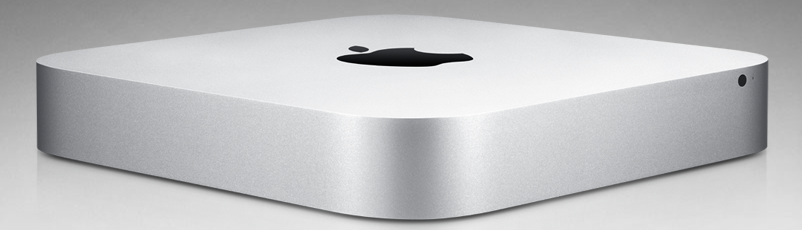
On my flat little squarish thing with rounded corners and the logo on top (note: I might skip the logo since the apple is probably proprietary and a watermelon would be too big, a grape too small, and a banana too long, yellow and phallicky. . . maybe I could try a negative image of itself - a slick drawing from a unique perspective - scaled down to about the same ratios as this one . . . oh, I don't know; I hate having to be creative) just as with this one, there wouldn't even be a button to start it. You'd just put it on your desk or coffee table and it would apparently do nothing for what would seem like forever and then at some unspecified, undesignated, indeterminate time in the future it would just work and suddenly you would see some kind of touch screen in the air hovering over it with images and text for suggested times and places to go visit in the past - maybe clickable ads for popular venues and things to wear and drink when you're there - and a box you could type in some address or other like Google Earth with a date and time of day, and then, zoom, you'd just go there to that place and time. Yes, you could type, because the thing would be projecting a holographic keyboard like this nifty little gizmo here:

The more specific the coordinates of the location on the space-time continuum you input, the better chance you would have of not ending up in a wall or a freeway or congress or something.
While waiting for it to become active, you'd just go about your daily life, such as it is and whatever it is. Or you could sit and stare at it like a TV. I could even invent a remote for it. There would be no apparent effect from clicking up or down the range of channels, but the exercise might have something to do with the mechanism for the activation of the machine itself. Probably most people would not notice any difference between doing this with the time-travel box and doing it with regular TV.
Whatever time and place you pick to time-travel to, the box would instantaneously give you fully developed skills in the language spoken and written there, so you could understand Homeric Greek or Elizabethan English or the Italian of the Renaissance or Rap Music without having to buy Rosetta Stone. I think it would do this by a process of molecular transformation of your brain which would be necessarily incidental to the manipulation of the time-space continuum entailed by time travel in the first place. Or maybe there would be a sort of wireless upload direct to the brain of something digitalized from the stem-cells of geniuses. Wait, both those ideas sound a little unscientific. This might be better. The box, upon becoming active, does its little number and sends itself far enough into the future where somebody smarter than I am has thought all this out, uploads whatever app is necessary for it to handle this language thing and then returns to your desk or coffee table instantaneously as if nothing had happened and you were still just staring at it, waiting for something to happen, idly clicking the remote.
Ooh ooh, I just remembered, it probably would be necessary add a thing in the holographic touch screen so you could set a duration for the trip, since once you got back to, say, the Renaissance, you'd have to wait a significantly longer time for the box to be invented in order to program yourself back to the present. Most people probably would not live that long. On the other hand, suppose you changed your mind and wanted to stay there, or you're in the middle something you really want to finish and forgot what time it was. . . Needs more thought. Or maybe I could just have the box include a life-expectancy enhancer as part of the overall time-travel experience which the box is capable of producing. . . yeah, that's it, some kind of a cross between a five hour energy drink, Viagra and penicillin. Or, maybe, wait a minute, okay, got it now - the experience includes a mind operated homing device like GPS: you just think yourself back to your original space-time continuum coordinates.
Or would it be better to have the box create some kind of eco-friendly vehicle for your time-space transportation pleasure, maybe like this?
 | ||
| (All I did here was google "weird ass electric cars" and this is one of the coolest images that popped up.) |
 | ||
| (Believe it or not, this sleek little dark charmer was on the same page as the geek-mobile above.) |
I'm not sure what happens after the box becomes active and you start time-traveling. I guess you could just go on time-traveling forever, although it is not clear what the term forever could reasonably mean. Maybe the short answer is that there there would be no point to the question, since basically for the thing to have become active there would have to have been some kind of holistic paradigm shift in the composition of the universe of such a kind and nature as to have caused to be filled, of its own volition - as it were - and without any apparent physical explanation, a perfectly empty, though really cool looking, box with some kind of time-travel circuit wizardry. Obviously, if that can happen then pretty much anything can happen.
Tuesday, May 31, 2011
Latin and the SAT
There is some interesting statistical information for Latin teachers and students in the 2010 College-Bound Seniors Total Group Profile Report by the College Board. It is accessible here: http://professionals.collegeboard.com/data-reports-research/sat/cb-seniors-2010
The information suggests a little inquiry into how students who take Latin fare on the Reading, Mathematics and Writing tests vis-a-vis students who take other languages and vis-a-vis students taking other subjects (not necessarily excluding foreign languages as well, I suppose). The base line is the average for all 1.5 million test-takers (Table 1):
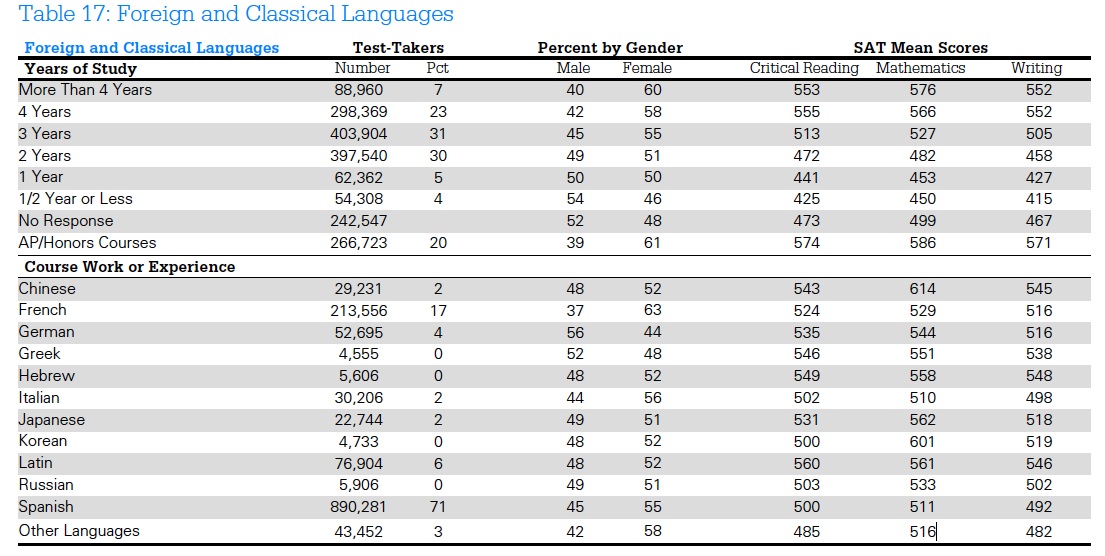
 Table 17 offers SAT mean scores for students taking different foreign languages, both by language and years pursued (including AP/Honors Courses).
 In the total of the mean scores, Latin (1667) is exceeded only by Chinese (1702). Latin is 50 to 60 points above the national average on each of the three mean scores. Spanish is almost dead on the national average. French - the other subject I teach - is in between. There are almost 11 times the number of Spanish students as Latin Students and almost three times the number of French students. As one would have suspected students who have taken an AP/Honors course or have pursued the study of a language at least four years or both, have significantly higher reading, math and writing mean scores than those who have not. Unfortunately this particular sub-set of data is not broken down by language. Where Latin stacks up with respect to correlations with other course work is more fully developed in Tables 15 - 18 (the others of which I am not going to cut and paste here). In these the figures indicate that of all the other course work mentioned (ten for English, five for Math, five for sciences, ten for History, eight for the Arts, six for Computers, as well as the nine other Foreign Languages besides Latin), only those taking Calculus (total mean scores: 1748 for 356,931 students) and Chinese (total mean scores: 1702 for 29,231 students) have higher mean SAT scores than were achieved by the 76,904 takers of Latin courses (total mean scores: 1667).
Just as one comparison - since courses revolving around the operation of computers seem to be proliferating - here is the same set of mean scores correlated with courses in, e.g., computer literacy, computer programming and the like. Since these are all around or close to the average scores, there would seem to be little correlation between these academic pursuits and better than average SAT scores.
 Table 20 offers the same data for students who took various subject tests. I break this down into two tables, one for the language tests and the other for English, History, Math and Science tests.

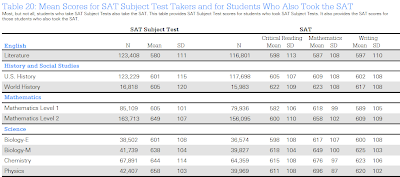
This tends to suggest that for students with sufficient confidence in a subject to sign up for a subject test, among foreign language students Latin students are easily in the top position with respect to their mean scores in Reading and Writing, and second only to Chinese students in Math (by only 3 points). I note that all the scores on this chart are way above the national averages, though again Spanish students are in the bottom position relative to the others. The Latin students also outscore in their mean Reading, Math and Writing scores all others testing in English, History, Math and Science, with the exception of Chemistry and Physics students who outscore them in Math. I suspect it is also noteworthy that the standard deviation on the three main tests for those taking the Latin subject test is the lowest of the whole bunch, indicating that these scores are all clustered more tightly around the numerical average.
One other interesting comparison is found in the tables on the Subject Tests Score Distributions (tables 21 - 24). I include here only table 24:
 Table 23 shows similar distributions for Chinese, French, German and Hebrew. It looks like Latin students were the least prepared to perform at the highest level on their particular subject test of any students taking any language subject test, and the distribution of their scores was almost even in each 50th from 800 down to 500. Nevertheless, as was obvious from Table 20, there is something about this particular group of 2,874 students which is correlated with a set of very high mean SAT scores.
I really don't know what that something is. There may be something about Latin that leads those who pursue its study for several years to have a higher than average competency level in reading comprehension, mathematical reasoning and writing skills. On the other hand, those who have higher than average competency levels in reading comprehension, mathematical reasoning and writing skills may gravitate (or be pushed) toward the study of Latin. Maybe there is something to both explanations.
The other question - related but perhaps more perplexing - is why the number of Latin students is so relatively low. Note that the number of students taking the Latin subject test is one percent of the total number of students taking subject tests. Note that the number of students who reported having taken Latin (76,094) is about five percent of the total SAT test takers (1,547,990). In my small high school (about 600 students fairly evenly distributed in grades 9 - 12), this year (2010-2011) there have been two Latin IV students and one Latin III student, zero French IV students and three French III students - i.e., about one percent in upper level Latin and in upper level French. There are about 30 French and 30 Latin students altogether over all four grade levels. There are more than twice as many Spanish students.
One would think that if high SAT scores really mattered there would be a lot more students taking Latin. Either hardly anybody has been paying attention to this batch of statistics (and they seem to have been pointing the same direction for years - check out Bolchazy-Carducci's [less than wholly candid] Latin advantage page), or perhaps only about five percent of the population actually has enough competency in reading comprehension, mathematical reasoning and writing skills to take Latin.
The information suggests a little inquiry into how students who take Latin fare on the Reading, Mathematics and Writing tests vis-a-vis students who take other languages and vis-a-vis students taking other subjects (not necessarily excluding foreign languages as well, I suppose). The base line is the average for all 1.5 million test-takers (Table 1):

Just as one comparison - since courses revolving around the operation of computers seem to be proliferating - here is the same set of mean scores correlated with courses in, e.g., computer literacy, computer programming and the like. Since these are all around or close to the average scores, there would seem to be little correlation between these academic pursuits and better than average SAT scores.


This tends to suggest that for students with sufficient confidence in a subject to sign up for a subject test, among foreign language students Latin students are easily in the top position with respect to their mean scores in Reading and Writing, and second only to Chinese students in Math (by only 3 points). I note that all the scores on this chart are way above the national averages, though again Spanish students are in the bottom position relative to the others. The Latin students also outscore in their mean Reading, Math and Writing scores all others testing in English, History, Math and Science, with the exception of Chemistry and Physics students who outscore them in Math. I suspect it is also noteworthy that the standard deviation on the three main tests for those taking the Latin subject test is the lowest of the whole bunch, indicating that these scores are all clustered more tightly around the numerical average.
One other interesting comparison is found in the tables on the Subject Tests Score Distributions (tables 21 - 24). I include here only table 24:

I really don't know what that something is. There may be something about Latin that leads those who pursue its study for several years to have a higher than average competency level in reading comprehension, mathematical reasoning and writing skills. On the other hand, those who have higher than average competency levels in reading comprehension, mathematical reasoning and writing skills may gravitate (or be pushed) toward the study of Latin. Maybe there is something to both explanations.
The other question - related but perhaps more perplexing - is why the number of Latin students is so relatively low. Note that the number of students taking the Latin subject test is one percent of the total number of students taking subject tests. Note that the number of students who reported having taken Latin (76,094) is about five percent of the total SAT test takers (1,547,990). In my small high school (about 600 students fairly evenly distributed in grades 9 - 12), this year (2010-2011) there have been two Latin IV students and one Latin III student, zero French IV students and three French III students - i.e., about one percent in upper level Latin and in upper level French. There are about 30 French and 30 Latin students altogether over all four grade levels. There are more than twice as many Spanish students.
One would think that if high SAT scores really mattered there would be a lot more students taking Latin. Either hardly anybody has been paying attention to this batch of statistics (and they seem to have been pointing the same direction for years - check out Bolchazy-Carducci's [less than wholly candid] Latin advantage page), or perhaps only about five percent of the population actually has enough competency in reading comprehension, mathematical reasoning and writing skills to take Latin.
Sunday, October 31, 2010
Labor improdus omnia vincit

This is the motto of Fond de l'étang - a boarding school for wayward boys in post-WWII France and the setting for Les Choristes, a 2004 French film directed by Christophe Barratier. A couple years ago I bought a DVD to watch with my French classes on the recommendation of my son who had spent a year in France a decade ago as a foreign exchange student. The motto - in large capital letters - appears one time in the film on a wall in a hall of the building as the new master is introduced to the place. Beneath the Latin and at the right is the ascription "Vergile".
Why is this motto so laughably mistaken? Vergil says in his Georgics I.145-6:
. . . labor omnia uicit 145A troublesome sentence to comprehend although not terribly difficult in vocabulary and syntax.
improbus et duris urgens in rebus egestas.
At the Erreurs de Films page on this movie appears this comment by "Michel B":
La devise du 'fond de l'étang', apparaît à un certain moment : 'labor improdus omnia vincit' ne signifie rien en latin. Il faut lire 'improbus' et non 'improdus' (Barbarisme).Possibly the error is intentional. The phrase in the motto has been around a good while. It produces at least 250 hits on Google (mostly European), among which appear glosses like this: Un travail opiniâtre vient à bout de tout. E.g. from the Institute of Physiology and Pathology of Hearing:
Officer's Cross "Labor Improdus Omnia Vincit" for scientific achievements of the Institute of Physiology and Pathology of Hearing, awarded at the 57th World Exhibition on Innovation, Research and New Technologies INNOVA 2008It seems to have been adopted as a tag-line by somebody going under the name "Gael" in a French listserv of some sort called Forum des Coquillards de Villon. You can see a representative post here. Of course, a goodly number - perhaps most - of the postings since 2004 may be parroting this film, wittingly or not, though it seems doubtful that the Officer's Cross thing derives from the movie, or at least from this version of the movie.
By contrast, the less incorrect "Labor improbus omnia vincit" produces some 18,000 hits on Google, and the shorter version (omitting the problematic attributive adjective) "Labor omnia vincit" some 67,000.
Perhaps the director or possibly the screenwriters (Barratier and Philippe Lopes-Curval, who were adapting the 1947 film La Cage aux Rossignols) have included this bit as a subtle - or not so subtle - comment on the pretensions of this internat de rééducation réservé aux enfants en difficulté. Throughout the film representatives of the school's administration confidently babble in (then) current psycho-socio-educational buzz-words, but they cannot even get a simple Latin quotation right on their proudly displayed motto. Rather, with a complete lack of genuine discernment, they latch onto some debased Latinate hard-work-is-good-for-you proverb floating around here or there and paste it up where it will impress the hoi polloi.
Perhaps it even goes further with a gentle but telling cut at the growing shallowness of a society coming adrift from its cultural roots. After all, nobody in the film comments on the error, or even appears to notice it. Nobody's education has included enough time with one of the preeminent writers of antiquity to recognize a misquote prominently displayed on the wall.
On the other hand, this may have appeared in the earlier film and simply been copied. In that case, we are back to wondering the same things about those involved in that earlier production.
Or is the real answer, as "Michel B" suggests, that these film people (whether in the later or the earlier or both versions of the story) just wanted a Latin motto saying something about the value of work and were too hasty and too cheap to get it right.
Saturday, October 30, 2010
Attendance, participation, cooperation and effort are the grade criteria applied by one physical education teacher (with thirty years or more of experience) at my school. I'm not sure why I asked him. He doesn't have a classroom this year, so I see him regularly in the science wing's utility room where there is a coffee-maker for the third floor. He was there working on grade entry work on his laptop when I stopped by for a re-fill one afternoon. I've been wondering a lot about grades the last few years, so I just inquired.
I suppose this set of criteria results in fairness. Students with little or no athletic ability (regardless of their motivation) and students with little or no ambition to reach a high level of accomplishment (regardless of their natural talent) can earn an A by attending, participating, cooperating and making an effort. The level of actual achievement in athletic pursuits, whether individual or group, indoors or outdoors, high-intensity or low-intensity, over the semester or academic year or even all four years of high school is irrelevant under this criteria. This may entail a dilution of the accomplishment of those who actually have a lot of ability or ambition or both, and consequently come to perform at a level of excellence, but who cares? By necessary implication that group of students will have attended, participated, cooperated and made an effort, so they will have their As too.
In my school an A for a semester of phys ed counts the same weight on the cumulative grade point average as an A for a semester in Latin. I can't help thinking that learning enough Latin vocabulary, morphology and syntax, and practicing thinking with all that Latin vocabulary, morphology and syntax well enough, to get As on my tests, quizzes and projects is necessary for a student to get an A in Latin. No doubt there is some correlation between this attitude of mine and the fact that there are three students in the third and fourth years of study in Latin out of a high school population of 600.
Statistic (from CDC): From 1980 through 2008, "the prevalence of obesity among adolescents aged 12 to 19 years increased from 5.0% to 18.1%" Is the appropriate reaction? (1) What the hell lousy kind of phys ed programs are schools running! (2) Without a phys ed course requirement this would be even worse. (3) Both?
Does anybody besides me wonder whether there is any causal relationship between the increasing number of fat kids and giving teenagers As in Gym if they show up, take part, get along nicely and give the impression of trying?
At least gym teachers are fortunate the bureaucrats in charge of such things as NCLB and PSSA haven't figured out how to hold schools responsible for making Olympic contenders out of whatever percentage of teenagers can fairly be described as porkers, weaklings, wimps or klutzes.
I suppose this set of criteria results in fairness. Students with little or no athletic ability (regardless of their motivation) and students with little or no ambition to reach a high level of accomplishment (regardless of their natural talent) can earn an A by attending, participating, cooperating and making an effort. The level of actual achievement in athletic pursuits, whether individual or group, indoors or outdoors, high-intensity or low-intensity, over the semester or academic year or even all four years of high school is irrelevant under this criteria. This may entail a dilution of the accomplishment of those who actually have a lot of ability or ambition or both, and consequently come to perform at a level of excellence, but who cares? By necessary implication that group of students will have attended, participated, cooperated and made an effort, so they will have their As too.
In my school an A for a semester of phys ed counts the same weight on the cumulative grade point average as an A for a semester in Latin. I can't help thinking that learning enough Latin vocabulary, morphology and syntax, and practicing thinking with all that Latin vocabulary, morphology and syntax well enough, to get As on my tests, quizzes and projects is necessary for a student to get an A in Latin. No doubt there is some correlation between this attitude of mine and the fact that there are three students in the third and fourth years of study in Latin out of a high school population of 600.
Statistic (from CDC): From 1980 through 2008, "the prevalence of obesity among adolescents aged 12 to 19 years increased from 5.0% to 18.1%" Is the appropriate reaction? (1) What the hell lousy kind of phys ed programs are schools running! (2) Without a phys ed course requirement this would be even worse. (3) Both?
Does anybody besides me wonder whether there is any causal relationship between the increasing number of fat kids and giving teenagers As in Gym if they show up, take part, get along nicely and give the impression of trying?
At least gym teachers are fortunate the bureaucrats in charge of such things as NCLB and PSSA haven't figured out how to hold schools responsible for making Olympic contenders out of whatever percentage of teenagers can fairly be described as porkers, weaklings, wimps or klutzes.
Sunday, December 6, 2009
 My youngest grandson - Austin Giles Snyder - born November 25, 2009.
It looks like he's been searching for the words with which to express his disapproval of something he has just noticed about his immediate environment and is just about to realize that he doesn't know any words yet, which is another thing he's about to disapprove of, except that the same problem with not knowing any words is going to come into play there as well, in consequence of all of which he can't do much of anything except get that expression on his face.

Subscribe to:
Posts (Atom)